Presidential dogs offer a glimpse of family life around a highly public office. They appear in photographs, letters, speeches and official archives, sometimes becoming celebrities themselves. Repeated anecdotes can acquire wrong names, breeds and dates.
George Washington's dogs had names
Mount Vernon's account of Washington's dogs identifies animals including Sweetlips and Vulcan. Their names have not been lost to history. Washington's interest in dogs belongs to his life at Mount Vernon and elsewhere; it should not be described as a story about his pets living in the present White House.
That distinction matters in any list of presidential pets. A dog owned before or after a presidency is not necessarily a White House resident. Likewise, an animal associated with the wider family may have lived in a different household.
Fala and Franklin D. Roosevelt
Fala was a Scottish Terrier and one of the most recognizable presidential companions. The FDR Library's account of Fala describes the puppy as a gift from Margaret Daisy Suckley in 1940. He traveled with Roosevelt and became part of the public image of the president.
The dog also featured in Roosevelt's 1944 campaign speech responding to a story that a naval vessel had been sent to retrieve him. The episode shows how an animal could become a subject of political humor and argument. Fala's name should not be translated into an unrelated word, as sometimes happens in poorly edited accounts.
Pushinka and the Kennedy family
Pushinka was a gift from Soviet leader Nikita Khrushchev to the Kennedy family. She was a daughter of Strelka, one of the Soviet dogs that returned from space. Pushinka herself was not the space traveler, and her name is commonly translated as fluffy.
The US State Department preserves Kennedy's June 1961 letter thanking Khrushchev for Pushinka. That date places the gift before the Cuban Missile Crisis of October 1962, not afterward as a reconciliation gesture.
Photographs of Pushinka and her puppies survive in the Kennedy collections. They connect an international exchange with ordinary domestic life, but they do not show that the gift resolved the broader tensions between the two governments.
Lyndon Johnson's Yuki
The White House Historical Association's account of presidential dogs identifies Yuki as a stray found at a Texas gas station by Johnson's daughter Luci. Photographs of Johnson and Yuki appearing to sing together became memorable images of their relationship. The dog's name was Yuki, not the mistranslated tractor found in some summaries.
Johnson also had beagles named Him and Her. Images involving the handling of their ears attracted criticism. Whatever the historical context, ears are not handles: modern readers should not copy rough handling simply because it appears in a famous photograph.
Gerald Ford's Liberty
The Gerald R. Ford Library's pet records identify Liberty as a Golden Retriever. She was not a Rottweiler. The records include correspondence about the dog and her puppies, showing how much interest a presidential pet could generate beyond the immediate family.
Letters and photographs are more dependable than a claim that every request for a walk stopped all government business. They allow readers to see the documented relationship without exaggerating it. A president enjoying a companion animal need not become a story in which the dog controls the entire administration.
Buddy and Socks in the Clinton household
The Clinton Library's exhibition on Socks and Buddy documents the family's cat and dog. Buddy was a chocolate Labrador Retriever, while Socks was the familiar black-and-white cat. Their public appearances and the attention they received are part of the history of pets becoming recognizable White House personalities.
Famous households still face ordinary animal-care challenges. A dog and cat should not be assumed compatible simply because both are friendly toward people. Historical stories about their relationship can prompt useful questions about introductions and separate spaces, but they are not a substitute for individual behavior assessment.
Barney and Miss Beazley
The George W. Bush Library's account of Barney and Miss Beazley identifies both dogs as Scottish Terriers. Barney became widely known through the administration's playful Barney Cam videos. These were a new way of presenting an animal's presence at the White House through the internet.
The archive illustrates a change in medium: pet stories moved beyond portraits, newspaper photographs and letters into online video. Such material is valuable evidence of how an administration communicated with the public. It should still be read as a produced presentation rather than an unfiltered record of every aspect of the dogs' lives.
Bo and Sunny: the Obama family's dogs
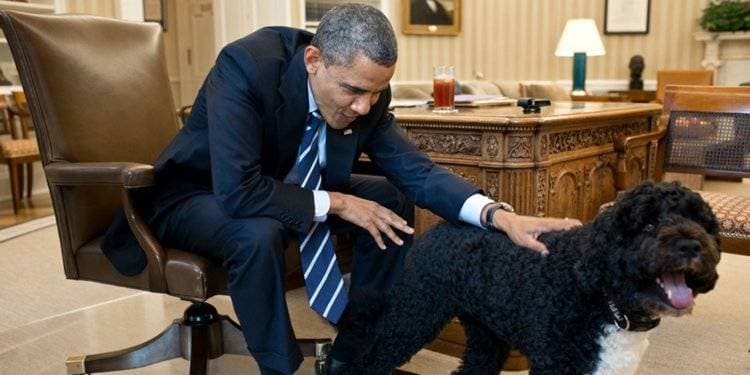
The uncertainty surrounding the Obama family's choice of a dog ended long ago. An official White House photograph records Bo's initial visit in March 2009 and notes that he came to live there in April. Bo was a Portuguese Water Dog, so an article should not continue presenting the choice between possible breeds as an unresolved competition.
Sunny, another Portuguese Water Dog, joined the family in 2013. The archived introduction to Sunny documents her arrival. Both dogs became familiar figures in photographs of the Obama years, rather than merely candidates discussed before the family selected a pet.
Their breed choice should not be treated as a medical guarantee for people with allergies. No dog breed is reliably free of allergens for every person. Families with allergy concerns need individual advice and a realistic care plan rather than choosing solely because a famous household owned the same breed.
Enjoy the stories without copying the decision
Not every president has kept a dog at the White House, and no official tradition requires one. Lists should distinguish documented pets from gifts, visiting animals and dogs owned outside the years in office. Numbers quoted without a defined source or time period can be particularly misleading.
For anyone considering a dog, presidential popularity is a poor substitute for meeting the animal and understanding its needs. Exercise, grooming, temperament, health and long-term care matter more than celebrity. The most useful lesson from these archives is that a public symbol is also an individual animal requiring ordinary, dependable care.