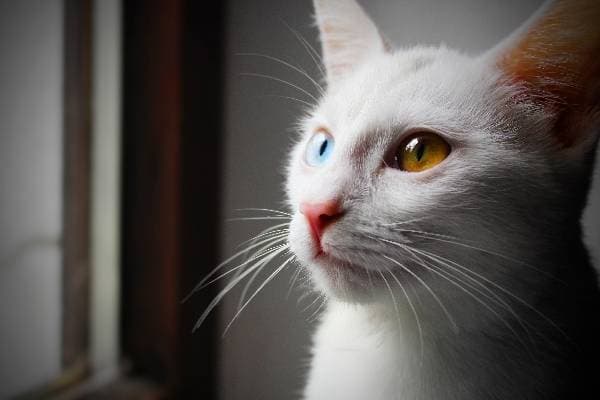
A cat with one blue eye and one green, amber or yellow eye has a form of heterochromia: a difference in iris color. This striking appearance occurs in several breeds and in cats without a pedigree. White fur and different-colored eyes alone do not prove that a cat belongs to a particular breed.
Eye color is also not a reliable hearing test. Some white cats hear normally, while others have congenital deafness in one or both ears. It is incorrect to claim that white Van cats can never be deaf or that most cats of a particular breed must be deaf without appropriate evidence.
Turkish Angora
The Turkish Angora is a distinct breed associated with Turkey, with a fine, silky coat and an elegant build. The CFA breed profile includes several colors and patterns, so white is not the only possible appearance. Eye color also varies. An individual cat's activity and willingness to sit on a lap cannot be predicted from coat color.
Ask a breeder for registration information and relevant health records rather than relying on photographs. When adopting a cat of uncertain ancestry, a description such as white domestic longhair may be more accurate than assigning a pedigree from looks alone. Either can be a much-loved companion.
Turkish Van and local Van cats
The registered Turkish Van is distinct from the Turkish Angora. The CFA Turkish Van profile describes the characteristic pattern with color concentrated on the head and tail against a largely white body. Local cats described as Van cats and registry-defined Turkish Vans should not automatically be treated as interchangeable populations.
Stories about every Van cat swimming, catching fish or descending from a single surviving animal should not be presented as established facts. Whatever its breed, never put a cat into water to test a supposed natural talent. Individual preferences and safe handling matter more than a romantic breed story.
Khao Manee
The Khao Manee is a Thai breed known for its white coat and jewel-like eyes. The CFA Khao Manee profile recognizes that its eyes need not always be different colors. A white kitten with blue eyes is not enough to establish this ancestry, and kitten eye appearance can change as development progresses.
Checking hearing responsibly
Cornell's guidance on white cats explains the association between white coats, blue eyes and inherited deafness. The relationship is a risk association, not a diagnosis for an individual cat. Ask a veterinarian about hearing assessment and, where appropriate, BAER testing, which evaluates auditory responses. Do not frighten a kitten with repeated loud noises to see whether it reacts.
A deaf cat can enjoy a good quality of life with thoughtful arrangements. Approach where it can see you, use consistent visual cues and avoid startling it from sleep. Secure indoor living or a protected outdoor enclosure helps manage hazards the cat cannot hear approaching.
Care beyond appearance
Provide regular veterinary care, suitable grooming and protection from excessive sun, particularly for exposed pale skin. Seek advice about any persistent sore on the ears or nose rather than treating it with household products. Choose a cat for the care and companionship you can provide, and evaluate its health as an individual rather than as an eye-color category.