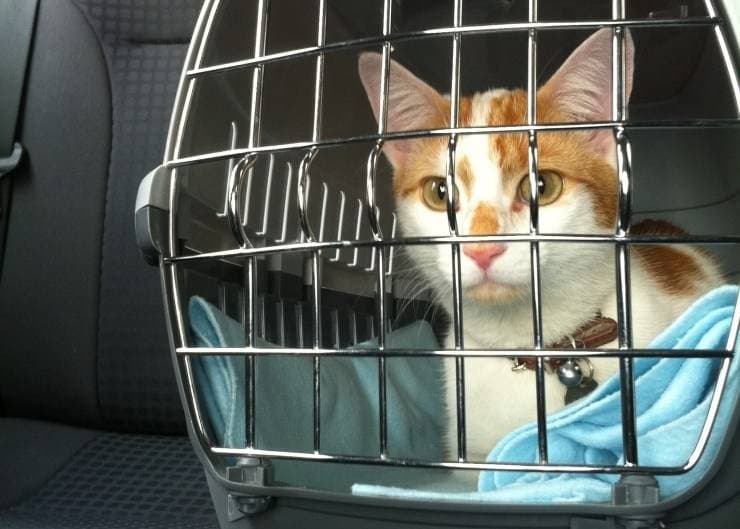
A safe cat journey begins with a suitable carrier, not an improvised sack or open basket. The carrier should be secure, well ventilated and large enough for the cat to stand, turn and lie comfortably. A firm base with appropriate bedding gives support and can make lifting less unsettling.
Choose for safety and access
Check doors, clips, seams and zips before every journey. A removable top can make some veterinary visits easier because a frightened cat may be examined without being pulled through a narrow door. Soft-sided carriers can also be suitable when their structure, ventilation and closures are dependable; synthetic fabric alone does not make a carrier unsafe.
Avoid ordinary bags, loosely fastened wicker baskets and cardboard containers that may soften, tear or open unexpectedly. Choose equipment rated for the cat's weight. For air travel, confirm the carrier requirements directly with the airline before purchasing or booking.
Make the carrier familiar
Leave it open in a quiet part of the home with familiar bedding inside. Offer rewards near it and then inside, letting the cat investigate voluntarily. Practice brief door closures and gentle lifting only after the cat is comfortable. International Cat Care's travel guidance emphasizes how carrier choice and preparation can reduce stress.
A light cover may help some cats feel sheltered, but keep ventilation clear and monitor temperature. Do not wrap the carrier tightly in heavy material. Familiar smells and predictable handling are more useful than forcing the cat to face a particular direction.
Secure the journey
Follow the carrier manufacturer's instructions for positioning and restraint in a vehicle. Keep it stable and away from direct sun. Never allow a cat to roam near the driver or pedals, and do not open the carrier beside a road or in an unsecured parking area.
Plan longer trips around the individual cat's needs for water, food, toileting and medication. Keep identification details current and carry relevant veterinary information. Never leave the cat alone in a parked vehicle, where temperatures can become unsafe quickly.
If travel causes severe distress, drooling or repeated vomiting, speak to your veterinarian in advance. Use medication only as prescribed for that cat, with any trial dose arranged according to professional advice. Preparation cannot guarantee a silent passenger, but it can make the journey safer and easier to manage.