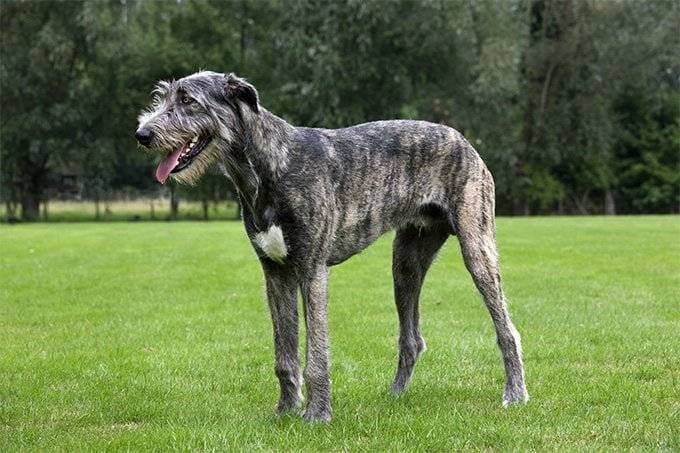
The Irish Wolfhound is a giant sighthound with a rough coat and a distinctive, long-legged outline. Many are gentle companions, but their size creates responsibilities that cannot be solved by a calm breed reputation. Housing, transport, veterinary care and everyday handling all need careful planning.
History and modern identity
The breed is associated with large hunting hounds in Irish history and with nineteenth-century efforts to preserve and develop the modern Irish Wolfhound. Ancient descriptions and legends should not be treated as a complete pedigree for today's dogs. Nor is a precise historical world-height ranking necessary to appreciate the breed.
The AKC Irish Wolfhound profile describes a tall, powerful hound built for speed as well as size. Coat colors vary within the standard. Choose comfortable movement, health and appropriate temperament rather than the tallest possible puppy or a promise of exceptional adult weight.
Space means more than a large garden
Provide enough room for the dog to stretch out comfortably without blocking every doorway. Think about floors, stairs, access to a vehicle and how you would transport an unwell adult. A giant dog needs a practical emergency plan because lifting it may require more than one person.
A secure garden can be useful, but it does not replace walks, companionship or training. The suitability of a home depends on access and routine as well as its address. Permanent isolation in a kennel is not a substitute for life with the household.
Use comfortable bedding and surfaces that give reasonable traction. Review arrangements as the dog ages or mobility changes. A resting place should remain quiet and accessible, with family members respecting the dog's need to sleep undisturbed.
Exercise and sighthound instincts
Offer regular walks and opportunities to explore at a pace suited to age and fitness. Growing puppies should not be pushed into forced running or repeated high-impact exercise. Discuss demanding activity with a veterinarian rather than assuming size equals endurance.
Movement can trigger chasing. Practice recall in secure settings and use a leash where roads, livestock or wildlife create risk. Fencing needs to contain the individual dog, and gates should be checked before access. A few successful recalls are not proof that every future distraction will be ignored.
Compatibility with cats and small animals varies. Careful introductions may help, but some pairings require ongoing separation. Do not assume that either a gentle reputation or a hunting history settles the question for every individual.
Training and family interactions
Teach calm greetings, loose-leash walking and waiting at doors while the puppy is still manageable. Reward cooperation and keep practice clear and brief. Family members should use consistent cues, and anyone walking the dog should be able to handle it safely.
An Irish Wolfhound must never be left responsible for children. Even a friendly movement can knock a small child over. Adults should supervise interactions and prevent climbing, pulling or disturbance during meals. Provide barriers when active supervision is not possible.
Do not encourage protective confrontation or assume the dog can identify every threat. A family companion needs predictable management around visitors. If fear, guarding or aggression appears, seek veterinary and qualified behavior support rather than trying to suppress warning signals.
Health planning for a giant breed
The Irish Wolfhound Club of America's health guidance highlights concerns including heart disease and gastric dilatation-volvulus, often called bloat or torsion. Ask about recommended parent screening, family history and ongoing cardiac assessment. Actual records are more useful than a general claim that a line is healthy.
Know the signs of a possible bloat emergency, including repeated unproductive retching, a distended abdomen, marked restlessness or collapse. Seek immediate veterinary care rather than waiting to see whether it passes. Ask your veterinarian about individual prevention options and an emergency destination before a crisis occurs.
Persistent limping, coughing, reduced stamina or changes in appetite deserve attention. Large dogs can have substantial treatment and medication costs, so budget realistically. Feed an appropriate complete diet and monitor body condition throughout growth and adulthood.
Regular brushing, nail checks and dental care remain important despite the breed's imposing size. A good match combines affection for the breed with practical preparation for the daily needs of the particular dog.