
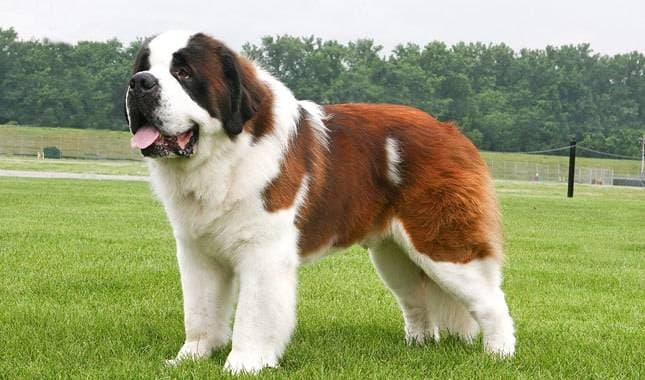
Strong, powerful, and beautiful dog is a St. Bernard. The breed owes its origin to the monk who in the Alps of Switzerland has created a kind of shelter for travelers. This place, as well as the path leading to it, was called after his name, St. Bernard. Hence, the name of the breed, a dog bred here.
To create such a large animal Asian dogs, Tibetan mastiffs with local representatives of dogs were crossed.
The reason of the Saint Bernard breeding
Settlement for monks and travelers was situated in a dangerous place. On the pass, located in the mountains, at an altitude of about 2500 meters higher than the sea level. Often, in these places, there were avalanches and steep mountain passes and strong winds did help people caught in the snow, difficult, and sometimes impossible.
The resulting breed ideally suited to work for the salvation of man from under the snowdrifts. An excellent scent helped to find the ravening, and thick skin did not let them to freeze. Another important ability of the Saint Bernard is an innate sense for the approaching avalanche.
Appearance
- The breed is different from other dogs with their large size. Its height at the withers is up to 0.7 m.
- The head is massive and wide, with prominent forehead, where the folds make wrinkles.There is a striking shift from the forehead down to the snout.
- Large, upper lips hang down markedly.
- Teeth have good strength.
- Eyes are slightly sunk, small, and brown. They are located near the bridge. Eyelids droop down, exposing the eye socket.In adolescence, the surgery is recommended, in order to avoid getting an infection in the eyes.
- The ears are hanging, of medium size.
- Neck is muscular; there is a marked collar around it.
- The body and limbs of the St. Bernard are massive.
- The hair can be short, but may be elongated, slightly wavy. It is usually painted in white and red spots.Red color may be of any shade.
- These dogs live an average 8 years.
Temper
- Despite the menacing look, St. Bernards have a good character. They are very fond of children, communicate very delicately with them.
- The dog is devoted to his master.It is easy to train; it is obedient and intelligent. Begin trainings from a very young age. Do not do it compulsively, without rudeness and shouting.
- When keeping this animal, it is better not to have other small pet.St. Bernards live together with another dogs only if grow with them up.
- In modern life, St. Bernard dogs are good guards and companions.
This dog needs a lot of space, many walks. Therefore, the apartment keeping is not recommended.
Updated Health Guidance
Veterinary guidance for giant breeds like the Saint Bernard has advanced since this article was written, particularly around bloat (gastric dilatation-volvulus), a life-threatening emergency this breed is especially prone to due to its deep chest. Vets now commonly recommend a prophylactic gastropexy, a procedure that tacks the stomach to the body wall to prevent it from twisting, often performed at the same time as spay or neuter surgery. Without it, roughly 1 in 5 at-risk dogs will experience a bloat episode in their lifetime. Spay/neuter timing has also been updated for giant breeds specifically: current guidance recommends waiting until 12 to 18 months old, since sex hormones support the joint development a dog this size depends on.
Beyond bloat, awareness of the breed's short average lifespan relative to its size (commonly 8 to 10 years) has also grown, with current guidance emphasizing early and regular joint-health monitoring, since giant breeds like the Saint Bernard are especially prone to arthritis as they age.


