If you are looking for a Dachshund around Portland, an in-person visit can tell you things a litter photo cannot: how the dogs live, how the breeder talks about the breed, and whether the puppy's everyday needs fit your household. Use the appointment to observe and ask questions rather than treating it as a quick chance to choose the smallest or most outgoing puppy.
Arrange a useful visit
Before driving across the metro area or out to a nearby community, confirm the full address, who will meet you, and how long the appointment will take. Ask whether you can see where the litter spends time and meet the mother. If the father lives elsewhere, ask for his name, health information, and temperament details. Ask what veterinary records and contract you will receive, what food the puppy eats, and how the breeder matches puppies with homes.
The American Kennel Club's guidance on responsible breeders recommends visiting the breeder, observing the premises, asking about parent dogs and health screenings, and getting answers to your questions. Use that as a prompt for a conversation, not a pass-or-fail score based on one detail.
Observe the setting, not just the puppy
Notice whether the dogs have clean water, a comfortable resting place, and space appropriate to their age. Look at how they respond to the breeder and to ordinary household activity. Puppies may be sleepy or shy during a visit; one brief interaction cannot predict adult temperament. Ask the breeder how each puppy behaves across the day and how they distinguish normal variation from a concern.
Pay attention to the seller's communication. Do they explain the puppies' routine and answer questions without rushing you? Do they ask about your schedule, stairs, other pets, and time at home? A careful breeder should be interested in where the puppy is going. You should receive time to read the agreement and records. Be cautious if the appointment turns into pressure to pay immediately, if explanations keep changing, or if promised records are unavailable.
Ask about health screening chosen for Dachshunds and request the actual documentation or the name of the testing program. A statement like “the parents are healthy” is not the same as a screening result. Ask what health issues occur in the breeder's lines, what signs they monitor, and what support is offered if a puppy needs veterinary care after going home. Share those records with your own veterinarian, who can explain what they do and do not show.
Ask Dachshund-specific questions
Dachshunds have a long-backed, short-legged build, so ask how the breeder supports safe movement as puppies grow. What surfaces do the puppies use? How are they introduced to being lifted? What does the breeder recommend about jumping on and off furniture, using stairs, and keeping the puppy at a healthy body condition? Ask for practical management ideas rather than promises that a particular puppy will never have a back problem.
The American College of Veterinary Surgeons' overview of intervertebral disc disease identifies Dachshunds among breeds with elevated risk. That information should lead to informed questions and a conversation with your veterinarian, not fear or a diagnosis of a puppy that appears healthy. Ask whether the parents or close relatives have had back problems, what the breeder observed, and whether there is a written plan for contacting the breeder if a future health issue arises.
Think about your own home honestly. Do you have a safe way to manage stairs? Can you supervise a puppy around furniture and children? If you live in an older Portland home with steep steps, decide where gates could go before the puppy arrives. A yard is not a substitute for leash skills, enrichment, and supervised time with the household.
Meet the puppy at its pace
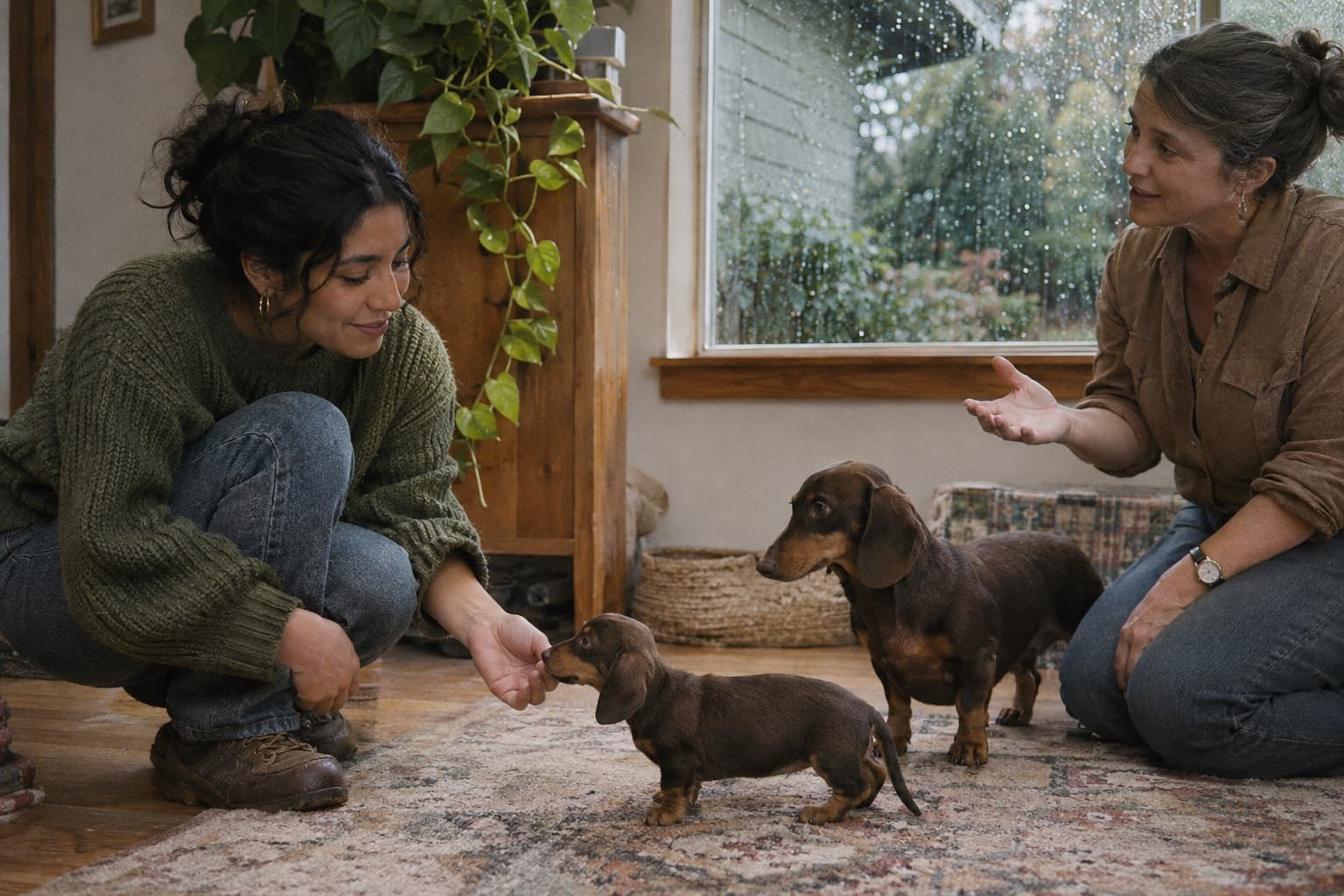
Sit down and let the puppy approach rather than reaching over it or passing it from person to person. Ask how the puppy has been handled and what it has experienced: household sounds, grooming, brief car trips, visitors, or time in a crate. Those experiences should be appropriate to the puppy's age and health. You are looking for gradual, thoughtful exposure, not a long list of dramatic “firsts.”
Do not choose only by coat color, size, or the first puppy to climb into your lap. Tell the breeder about your household routine and ask which puppy may suit it, with examples. A thoughtful match is a conversation about temperament and care, not a guarantee that any puppy will behave exactly as expected.
Before you leave the Portland area
Ask for copies of the veterinary examination, vaccination and parasite-treatment dates, microchip details if applicable, feeding instructions, and any registration documents promised in writing. Read the contract carefully. Find out whether the breeder expects you to return the dog if you cannot keep it and whom to call with questions. Confirm the pickup date is appropriate for the puppy's development and local requirements.
There is no need to decide in the driveway. A responsible seller should give you space to review the information and speak with your household. If something feels unclear, pause, ask for documentation, and consult your veterinarian. A good visit should leave you better informed, whether or not you choose that puppy.
Image: AI-generated editorial image for AnimalsSale; the people and dogs are illustrative, not a real breeder or litter.