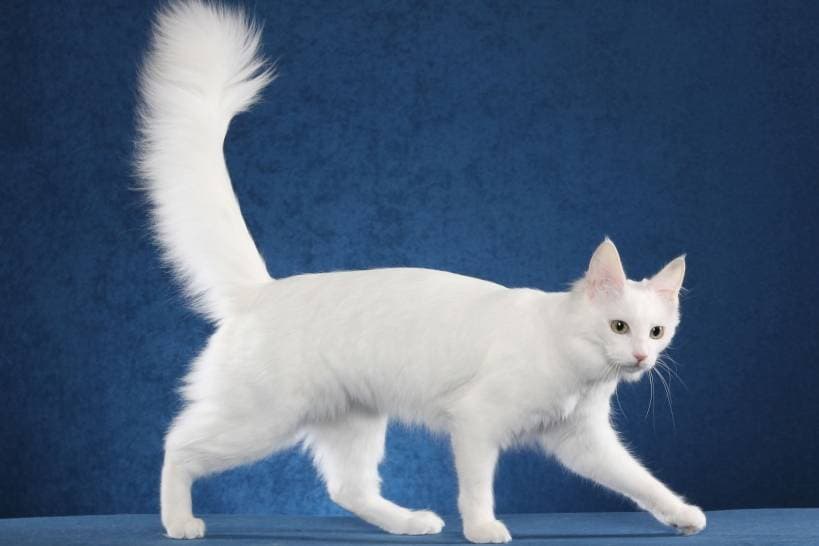
The Turkish Angora is associated with the Ankara region of Turkey; Angora is an older name for Ankara. Its graceful build, silky coat and plumed tail are characteristic, but a longhaired white cat is not automatically a pedigree Turkish Angora.
History and appearance
The Cat Fanciers' Association describes the breed's Turkish origins and preservation history. Claims that its modern development began through an Egyptian route or a German registration campaign should not be presented as settled history without reliable evidence.
Turkish Angoras occur in several colors and patterns, not only white. Eye color also varies. Their coat is generally finer and less heavily undercoated than a Persian's, but individual grooming needs still differ.
An active companion
Many enjoy climbing, play and interaction with familiar people. This does not mean every cat will sit on a lap or adapt immediately to children and other pets. Personality, early experience and the environment all influence how a cat responds.
Provide stable climbing places, scratching surfaces and daily play opportunities. Let the cat choose when to approach and give it a quiet retreat. Describing an independent cat as arrogant or determined to lead the household adds little to understanding its needs.
Groom without forcing
Comb regularly to remove loose hair and check for tangles, especially in areas that rub during movement. Introduce care in short, gentle sessions and reward cooperation. A fine coat still needs inspection for skin changes or painful areas.
Routine bathing is not necessary for every cat. If cleaning is needed, use a suitable method and product with professional advice where appropriate. Neither a love nor a fear of water can be guaranteed from breed alone.
Consider hearing and health
Some white cats have congenital deafness, with risk associated with pigmentation and blue eyes, but not every white or blue-eyed cat is deaf. Cornell's information on white-cat hearing explains the association. A veterinary hearing assessment is more useful than judging from appearance or a casual reaction to noise.
A deaf cat can have a good quality of life with suitable adaptations. Keep it protected from traffic and other outdoor hazards, use predictable visual or gentle tactile cues and avoid startling it awake.
Prepare for daily care
Feed a complete diet appropriate to age and health, monitor body condition and maintain preventive veterinary care. Ask for health and pedigree records when acquiring a cat, and arrange an initial examination.
Secure windows and balconies and offer enrichment rather than relying on unrestricted roaming. A comfortable home for a Turkish Angora is one that supports activity, choice and gentle interaction, without expecting every cat to match a romantic description of the breed.